Showing posts with label Spain. Show all posts

Tuesday, 26 June 2012

A bumper weekend for Spain and Alonso


As Fernando Alonso rounded the final turn of the sinuous Valencia Circuit to grab victory, he compounded a bumper weekend for Spanish sport and anyone named Alonso. Fernando’s footballing namesake Xavi struck two past the hapless French to reach the Euro 2012 Semi-Finals. 

For F1’s Alonso, victory was particularly sweet. At the start of the season everyone had discounted Ferrari as also-rans after their new F2012’s disappointing performance in winter testing. The car was clearly difficult to drive, with Alonso and his beleagured teammate Felipe Massa seconds off the pace. 

But thanks to Alonso’s brilliance and the unpredictability of the new Pirelli tyres, the Spanish driver has been in the hunt from the start, hustling a recalcitrant car to the top as the main competitors faltered. 

His win in Malaysia, where he overcame rain, a lowly grid position and a charging Sergio Perez, was testament to his ruthless competitive spirit. Nowhere was this more apparent than on the streets of Valencia this weekend. 

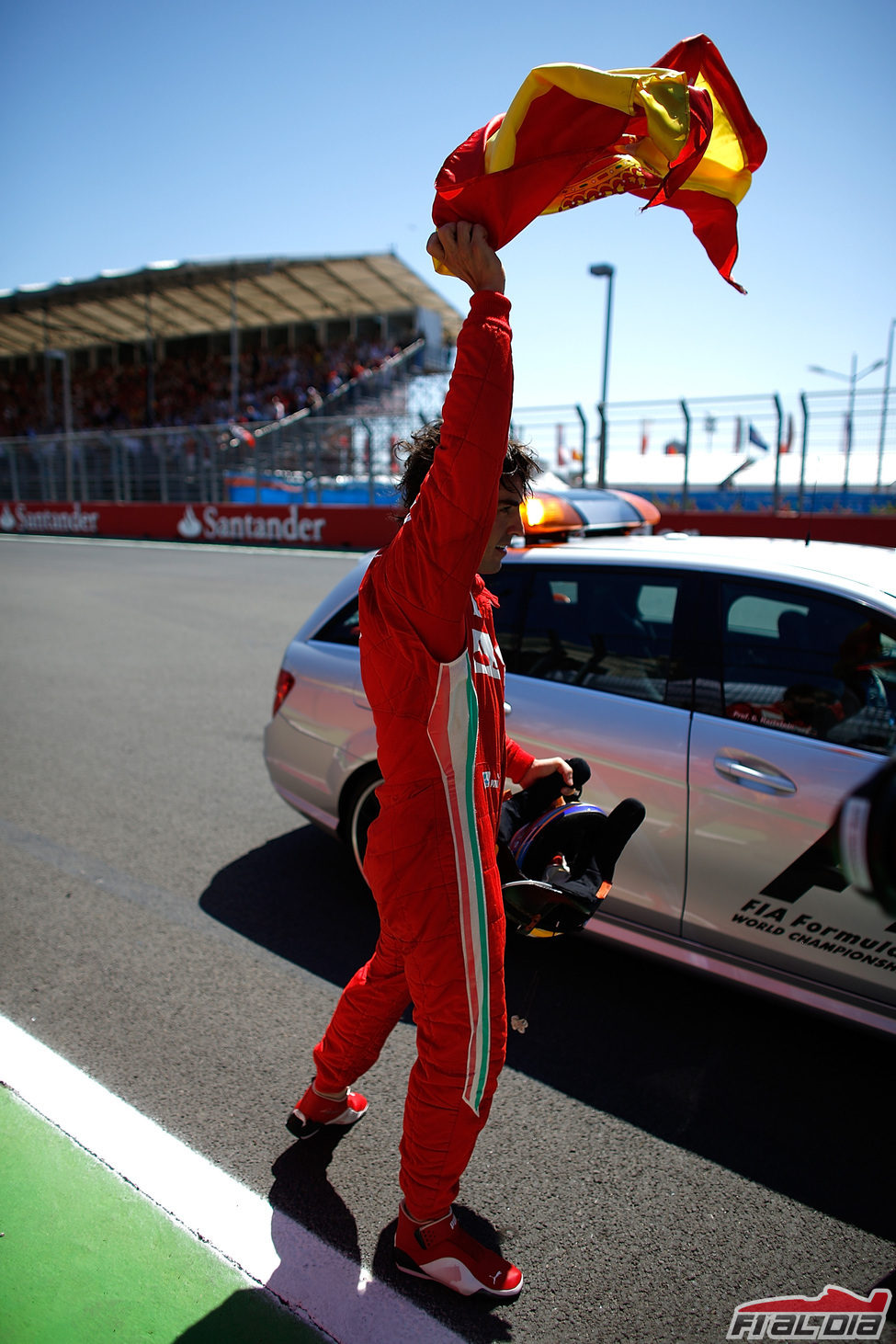
Alonso salutes his adoring home fans
Starting eleventh, he catapulted to 8th on the opening lap and quickly dispatched Hulkenberg and Maldonado. Slick pit-work by the Ferrari team allowed him to capitalise on the misfortunes of both Kimi Raikkonen and Kamui Kobayashi, who lost precious seconds as their teams blundered their tyre changes.

 Whilst Sebastian Vettel remained in the lead and continued to pump in quick laps with peerless consistency, Alonso was now in touch with the chasing duo of Lewis Hamilton and Romain Grosjean. A win still seemed unlikely. But suddenly the race was blown wide open. 

Backmarkers Vergne and Kovalainen clumsily collided, throwing debris onto the track. Out came the safety car andVettel’s 20-second lead was erased. Whilst Hamilton suffered pit-lane woes, both Vettel and Grosjean succumbed to alternator failures as their cars’ electronics faltered in the Mediterranean heat. 

Alonso claimed the lead and held on for his 29th career victory. Fighting back tears on the podium amid the crowd’s deafening patriotic roar, Alonso, like Spain’s footballers, looks well-placed to claim another championship.

Tuesday, 10 April 2012

Now Sarkozy ruffles feathers in Madrid as the election battle hots up


Just like Manchester City after Mikel Arteta’s booming 87th minute strike yesterday, Nicolas Sarkozy is staring down the barrel of defeat. If the latest polls are to be believed, socialist rival Francois Hollande is pulling clear. Now Carla Bruni’s diminutive husband is trying to fight back. His latest tactic? Breaking his long-held solidarity with fellow EU nations by criticising Greece and, more contentiously, Spain.

A lot to ponder
Sarkozy sounded a cautionary note to voters against the socialists' economic model, heaping blame on “seven years of socialist government” for Spain’s current problems. It was a direct stab at the tenure of prime minister Jose Luis Zapatero between 2004 and 2011, which met with a cold reception in Madrid even among the conservatives.

The socialist PSOE, formerly headed by Zapatero, immediately pointed to Sarkozy’s own credentials, highlighting France’s high public debt. The new conservative Finance Minister, Luis de Guindos, dismissed Sarkozy’s remarks as mere campaigning and branding the comparisons with Greece “unjust”.

Sarkozy may have a point. Spain’s economy is hardly in rude health – its national debt still sits above €15000 per capita. But singling out a fellow EU member as an object lesson in economic mismanagement is surely a step too far, particularly in the current climate. Never in its 54-year history has the EU needed to be more unified. With eurozone break-up still possible and the IMF reluctant to step in with bailout money, political infighting is the last thing Europe’s leaders should be doing.

With the elections now imminent and the final push for votes underway, it seems Sarkozy is feeling the pressure from Hollande. His PR team has been in overdrive during the last few weeks and Sarkozy has hit out at his socialist rival at every opportunity.

His most recent piece of rhetoric was a 34-page document simply titled “letter to the French People”, which tried to show solidarity with his people whilst asserting his presidential gravitas. It even began with a hand-written note extolling his brand of (nauseating) patriotism: “my dear compatriots, there is nothing more beautiful than love for one’s country.”

But his patriotism was more decorative garnish, masking the document’s true agenda with a layer of populist jingoism. The majority of the letter was devoted to criticising Hollande’s policies rather than offering anything new or constructive. But the reductive politics of sniping at rivals is classic Sarkozy.

His tactic of outlining his politics via letter is also nothing new. In his bid for re-election in 1987 the socialist President Francois Mitterrand drafted a similar document addressed to the French people with exactly the same name. His goal was to build an image of him as experienced and trustworthy, almost avuncular, positioning himself above the cheap political point-scoring of his rival Jacques Chirac.

But the glaring irony of Sarkozy’s tactics will not be lost on the socialists. The fact that he, the enemy of everything Mitterrand stood for, is now changing tack and trying to imitate the former president, will probably leave the socialist ranks tittering with laughter.

Monday, 2 April 2012

Spain's Catch-22 - Strikes and the 'Summer of Discontent'


Friday in Madrid, the morning after the strike. The paving slabs of the central plaza are covered in the papery mulch of discarded leaflets from last night's protest. Bins are still unemptied,  overflowing with red plastic flags bearing union logos. Buildings are pock-marked with anti-authoritarian slogans in black spray paint.

This was the sixth general strike in Spain's history and the first since 2002. Unions claim 900,000 took to the streets. Police put the numbers below 100,000. The real figure, - somewhere between six and seven hundred-thousand, is still enormous.

Spain is losing patience with her government. Although the rally passed without violence, the vehemence of the protesters and sheer weight of numbers present will worry Spanish authorities. Placards bearing “No hope, no jobs, no money” neatly encapsulate the country's problems. Banners with the message “total violence: let’s steal food and rob houses” carried impact but were meant more in jest than as a call to arms for widespread anarchy.

But this second mantra could become more real as the problems worsen. The simmering anger of the Madrid residents could be a portent of more animated protests as government cutbacks and reforms begin to bite harder.

Tellingly it was the younger generations who made their voices heard. Spain has approaching 50% youth unemployment and faces the prospect of a lost generation who will pass into middle age with little work experience. Young people, some only sixteen, led the anti-authoritarian charge, with chants and banners carrying unprintable messages directed at police, banks, and the newly-elected Prime Minister, Mariano Rajoy.

Rajoy's conservative Partido Populista is feverishly cutting back to reduce the national debt, - currently almost 9%. In 2011 the country fell 2.5% short of its reduction target and now the 5.3% proposed by the EU seems wildly optimistic. The PP has stepped up its efforts, with a so-called 'rationalisation' of the banking sector and new labour reforms.

The latest reforms are the main source of anger for Spanish workers and the reason for strike. The crux of the proposals is the reduced compensation package available to workers after being fired – which makes it easier for companies to lay them off and so reduce overheads. In effect, jobs in an already shaky market are now even more transient.

The proposal also increases the levy on jobs for large and medium-sized companies, to help increase government revenue.

Rajoy and his cabinet have set out their austerity plan using the UK's as a model – though taking it further with more severe public investment cutbacks. But while Cameron's austerity measures (and the Bank of England's periodic injections of capital via Quantative Easing) are slowly and painfully clawing the UK out of debt, Spain is a different case entirely.

Whereas the UK’s national debt sits near 3% with the economy slightly growing (0.8% in 2011), Spain is still mired in deep recession. For a population already at breaking point with tax hikes and cutbacks, the idea of further squeezing seems impossible. Rajoy’s government seems fixated on meeting the EU’s unrealistic targets at all costs – even that of his people’s welfare. On Thursday the rhetoric of the unions was damning – branding the EU and Angela Merkel “tyrannical” for insisting that Spain meet its outlandish targets, whilst castigating Rajoy as “spineless” for submitting to their demands.

In reality he has little choice. The government has a near-irreconcilable balancing act between the demands of the EU and its own people. PSOE, the socialist party in favour of the strikes, suggests suspending the cutbacks for a few years to stimulate job creation. But this would only prolong the pain, leaving Spain swamped in debt for years to come and extending the repercussions for the eurozone, whose bailout strategy depends on Spain returning to the black.

For Spain there is no magic formula. It is likely to be several years before its debts are paid and the road to recovery is littered with obstacles. The remedy – higher taxes, more cuts and perhaps even more drastic reforms – will likely make Mariano Rajoy's PP politically toxic and usher in the return of the socialists. The regions of Asturias and Murcia have already rejected the PP in local elections.

Short term public outcry could make the next few months Spain's 'summer of discontent'. The air of unease on Thursday was almost palpable. Mounted police paced towards the crowds of striking workers. Beret-clad police officers stood uneasily in front armoured riot vans next to the city hall.

In the event there was no need for heavy-handed tactics to keep civil order. But the situation could become more heated if the government turns the screw further. Rajoy's next move will be decisive in keeping his people in check.