Showing posts with label Formula One. Show all posts

Tuesday, 26 June 2012

A bumper weekend for Spain and Alonso


As Fernando Alonso rounded the final turn of the sinuous Valencia Circuit to grab victory, he compounded a bumper weekend for Spanish sport and anyone named Alonso. Fernando’s footballing namesake Xavi struck two past the hapless French to reach the Euro 2012 Semi-Finals. 

For F1’s Alonso, victory was particularly sweet. At the start of the season everyone had discounted Ferrari as also-rans after their new F2012’s disappointing performance in winter testing. The car was clearly difficult to drive, with Alonso and his beleagured teammate Felipe Massa seconds off the pace. 

But thanks to Alonso’s brilliance and the unpredictability of the new Pirelli tyres, the Spanish driver has been in the hunt from the start, hustling a recalcitrant car to the top as the main competitors faltered. 

His win in Malaysia, where he overcame rain, a lowly grid position and a charging Sergio Perez, was testament to his ruthless competitive spirit. Nowhere was this more apparent than on the streets of Valencia this weekend. 

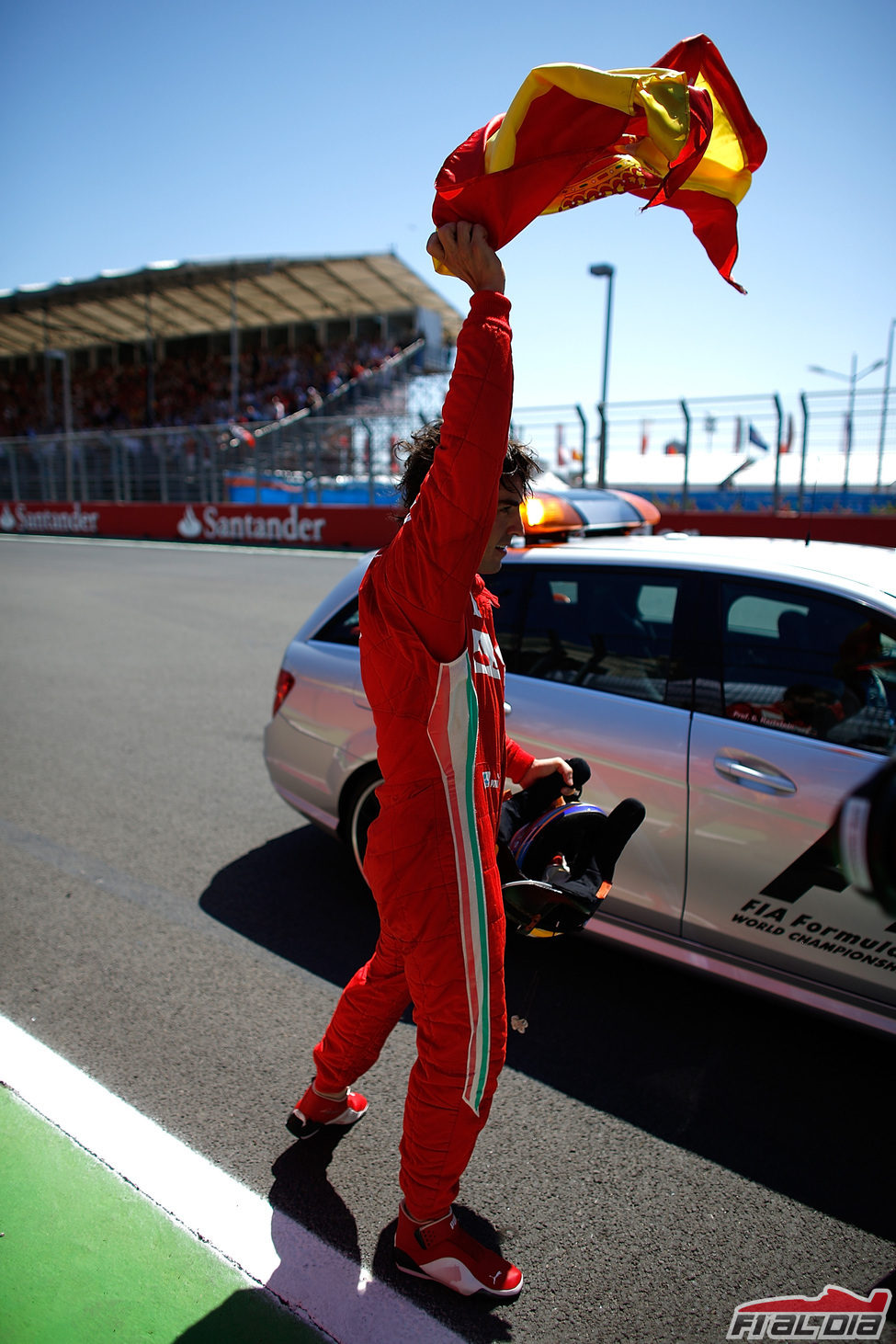
Alonso salutes his adoring home fans
Starting eleventh, he catapulted to 8th on the opening lap and quickly dispatched Hulkenberg and Maldonado. Slick pit-work by the Ferrari team allowed him to capitalise on the misfortunes of both Kimi Raikkonen and Kamui Kobayashi, who lost precious seconds as their teams blundered their tyre changes.

 Whilst Sebastian Vettel remained in the lead and continued to pump in quick laps with peerless consistency, Alonso was now in touch with the chasing duo of Lewis Hamilton and Romain Grosjean. A win still seemed unlikely. But suddenly the race was blown wide open. 

Backmarkers Vergne and Kovalainen clumsily collided, throwing debris onto the track. Out came the safety car andVettel’s 20-second lead was erased. Whilst Hamilton suffered pit-lane woes, both Vettel and Grosjean succumbed to alternator failures as their cars’ electronics faltered in the Mediterranean heat. 

Alonso claimed the lead and held on for his 29th career victory. Fighting back tears on the podium amid the crowd’s deafening patriotic roar, Alonso, like Spain’s footballers, looks well-placed to claim another championship.

Thursday, 19 April 2012

Sport and politics shouldn't mix – but sometimes they must.


The Bahrain Question - why F1 must take a stand


Shanghai International Circuit, fifty miles south of Shanghai. Its collection of soaring towers and vast stadium complex provide an impressive backdrop to the world's premier motorsport competition. For a few hours on Sunday, as Nico Rosberg's silver Mercedes lapped effortlessly to a long-overdue first victory, all appeared serene in the world of Formula One. But throughout the weekend off-track politics have cast a shadow over the sport's competitive side.

The Chinese circuit is among F1's most impressive venues, testament to the incredible wealth poured into the sport by emerging economies in recent years. But despite China's questionable human rights record, it is Bahrain, another economy whose riches have swelled the F1 coffers, which is attracting all the headlines. The Bahrain Grand Prix is due to run this weekend and despite the kingdom being gripped by mass uprising and demonstration against the totalitarian regime, the race is still going ahead.

Bahrain, particularly the capital Manama, has been in lockdown at various points for well over a year. Since the Arab Spring in early 2011 thousands of mostly Shi'ite protesters have taken to the streets, bidding for freedom and an end to the hereditary monarchy of the Sunni elite, the Al-Khalifa royal family.

Whilst last years' event was cancelled on safety grounds, this year organisers are pressing ahead as though all is normal. This is not the case. The regime has kept dissidents from taking control with violence and shocking reprisals. Stun grenades, tear gas, rubber bullets and even live ammunition have been used against protesters. At some points the authorities even resorted to the army's tanks and overseas mercenaries. Political opponents, such as Abdulkarim Ali Ahmed Fakhrawl, a newspaper editor, have been brutally tortured.

Naturally the FIA, F1's governing body, have wheeled out the predictable line that the sport and politics should not mix. But mix the two is exactly what the race's promoters have done. The promotional tagline “uniF1ed – a nation in celebration” paints a criminally distorted picture of the real situation, effectively using Formula 1 as a propaganda tool to wash over the discord.

In reality, the exact opposite is true.

Far from a unifying force, F1 has become a symbol of the oppression of the ruling class in Bahrain. Its benefits – colossal advertising revenues and contributions to the local economy – are mostly confined to the elite section of society which subjugates the rest. In effect, Formula One's presence is allowing the existing regime to solidify its position with the enormous financial windfall it provides.

It is hardly surprising that F1 – and its self-styled 'ringmaster', Bernie Ecclestone – have polarised the protesters' anger in recent weeks. Protesters have burned pictures of Ecclestone and banners and graffiti have all appeared carrying messages with a similar rallying call: “No Formula One over our blood”.

Disappointingly it seems that money speaks louder than morals. For Ecclestone and Formula One's parent company CVC Bahrain is an enormous cash-cow, bringing in £40 million in promotor's fees alone.

Formula One has the opportunity to strike a blow for the freedom of a repressed people. Calling off the race would make the position of a cruel regime even more untenable. Bahrain is a small nation of 1.6 million people and Formula One contributes significantly to its economy every year. Comparisons with other sporting events in other controversial regimes, such as the former Soviet Union, or present day China, are null and void. Jimmy Carter's decision to prevent U.S athletes from competing in the 1980 Olympics in the then-U.S.S.R. made negligible impact on the overall Soviet regime because in the event the politics played little part in the running of the event. Protests surrounding Beijing 2008 again had little effect.

The Bahraini government is using F1 as a PR mechanism, attempting to divert international eyes away from its contemptible treatment of its people. Meanwhile the FIA and F1 itself is playing a dangerous game of brinksmanship in the name of profit, tacitly supporting a brutal regime by holding the race. But, with the violence set to continue, will this short term profit cause long term damage to the sport?