Showing posts with label Lotus. Show all posts

Tuesday, 26 June 2012

A bumper weekend for Spain and Alonso


As Fernando Alonso rounded the final turn of the sinuous Valencia Circuit to grab victory, he compounded a bumper weekend for Spanish sport and anyone named Alonso. Fernando’s footballing namesake Xavi struck two past the hapless French to reach the Euro 2012 Semi-Finals. 

For F1’s Alonso, victory was particularly sweet. At the start of the season everyone had discounted Ferrari as also-rans after their new F2012’s disappointing performance in winter testing. The car was clearly difficult to drive, with Alonso and his beleagured teammate Felipe Massa seconds off the pace. 

But thanks to Alonso’s brilliance and the unpredictability of the new Pirelli tyres, the Spanish driver has been in the hunt from the start, hustling a recalcitrant car to the top as the main competitors faltered. 

His win in Malaysia, where he overcame rain, a lowly grid position and a charging Sergio Perez, was testament to his ruthless competitive spirit. Nowhere was this more apparent than on the streets of Valencia this weekend. 

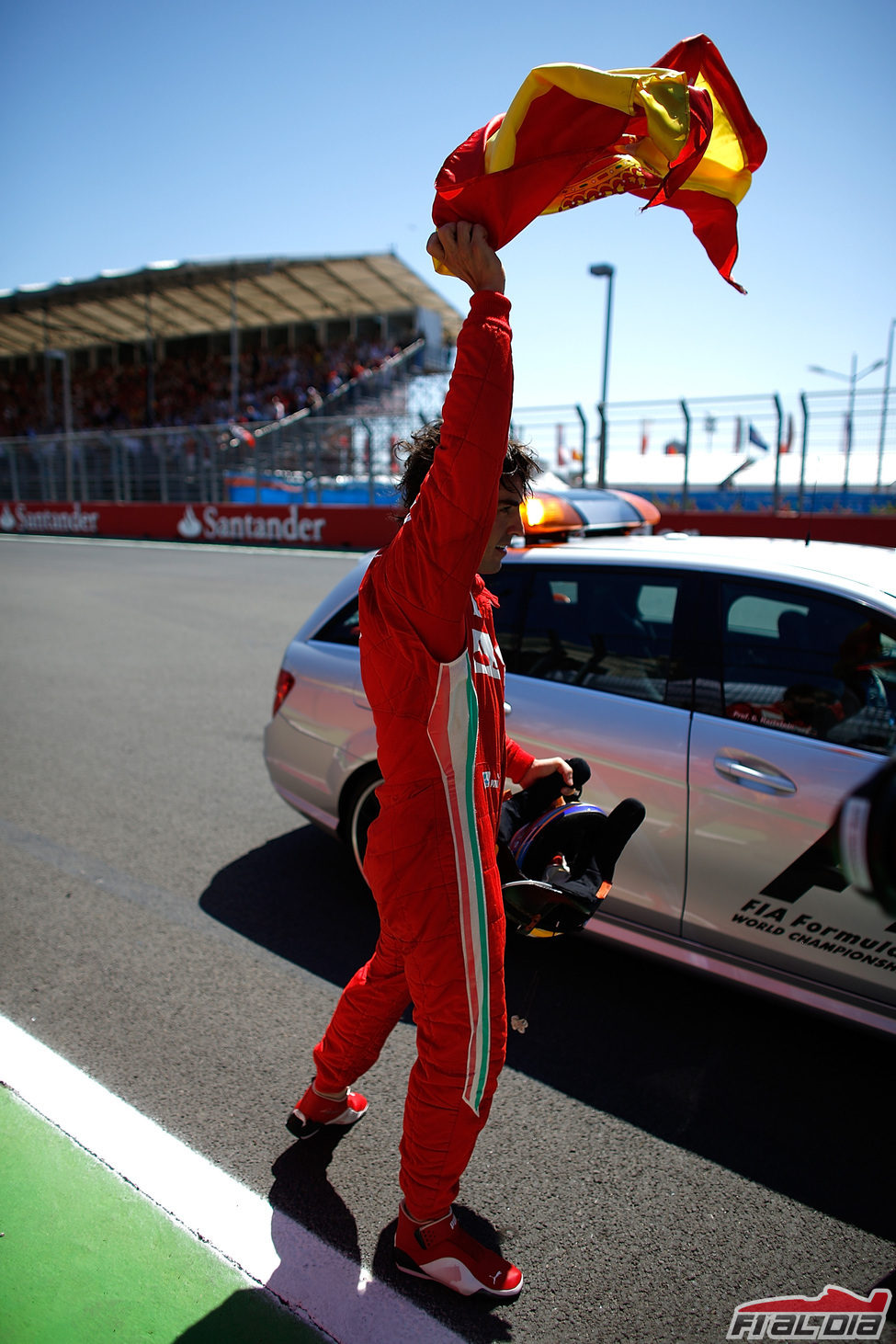
Alonso salutes his adoring home fans
Starting eleventh, he catapulted to 8th on the opening lap and quickly dispatched Hulkenberg and Maldonado. Slick pit-work by the Ferrari team allowed him to capitalise on the misfortunes of both Kimi Raikkonen and Kamui Kobayashi, who lost precious seconds as their teams blundered their tyre changes.

 Whilst Sebastian Vettel remained in the lead and continued to pump in quick laps with peerless consistency, Alonso was now in touch with the chasing duo of Lewis Hamilton and Romain Grosjean. A win still seemed unlikely. But suddenly the race was blown wide open. 

Backmarkers Vergne and Kovalainen clumsily collided, throwing debris onto the track. Out came the safety car andVettel’s 20-second lead was erased. Whilst Hamilton suffered pit-lane woes, both Vettel and Grosjean succumbed to alternator failures as their cars’ electronics faltered in the Mediterranean heat. 

Alonso claimed the lead and held on for his 29th career victory. Fighting back tears on the podium amid the crowd’s deafening patriotic roar, Alonso, like Spain’s footballers, looks well-placed to claim another championship.

Friday, 16 March 2012

More questions than answers? Conclusions from Free Practice at Albert Park

For anyone expecting the season’s first F1 practice session to leave us much the wiser of the current form book, they were sorely disappointed. 

Melbourne’s typical bright autumnal sunshine was replaced by a selection of cloud and intermittent rain, hardly optimum conditions for F1 cars to stretch their legs and push the limits of performance.

None of the teams showed its real hand today. 

Mercedes and Michael Schumacher topped the timesheets, with the German 7-time world champion proclaiming himself happy with his runs. 

Red Bull looked muted – from the onboard footage Vettel was clearly leaving performance to spare. 

From its body language the car was not squirming around on the limit of adhesion even on the low grip of a moist track. Through the final turn, the fast right-hander where drivers deftly
feed in the power as the corner opens out, there was no hint of him ‘chasing’ the throttle or correcting rear-end slide.

Why should he? It wasn’t worth the risk. The cost of slamming the car into the wall, as Karun Chandhok did last year, would have far outweighed any benefit the team could have gained – the use of any data collected from running on a damp track is dubious at best.

Many other teams followed a similarly low-risk procedure. McLaren looked strong and clearly had performance to spare, whilst Force India underlined their solid testing pace with confident-looking laps from both di Resta and Hulkenberg. 

Their car looked planted and the drivers seemed comfortable from the off, a positive sign for Sunday, where in a race which so often produces surprise results predictability is valuable.

Ferrari's radical pull-rod derived F12 looked a handful in the hands of both Alonso and Massa, the Spaniard suffering several mid-corner wobbles whilst the Brazilian ham-fistedly beaching the car into the gravel after a careless spin at turn 9. 

The car looked visibly less planted than the McLaren or Red Bull, or even the Mercedes. 

Much paddock talk has been devoted to the Mercedes' new wing-stalling DRS enhancer but until its effectiveness can be measured more empirically it's difficult to quantify how valuable it is in reducing lap time.

HRT and its principal Luis Perez Sala looked sheepish after sessions to forget. Not only was the car slow, but unreliable – Narain Karthikeyan stopped on track in free practice 1 and De La Rosa completed a single installation lap. Karthikeyan eventually lapped 13 seconds slower than Schumacher. 

There should be more to come from the team – one hopes Karthikeyan was erring on the side of caution – but for many paddock insiders it will be a long shot if the team even qualifies. Apparently more personnel from Sky are present at Albert Park than from the entire HRT team, which says something about priorities. 

It's premature to ring a team's death knell after two inconclusive sessions but HRT could become a Mastercard-Lola type fracas (the short-lived 1997 team that arrived in Australia 13 seconds off the pace). But with the experience of Pedro de la Rosa the team should begin to make strides. They will certainly need to.

Lotus and 2007 world champion Kimi Raikkonen were also muted, the Finn complaining of a lack of power steering feel similar to the one that blighted his testing at Jerez.

The problem seems to have been partially resolved as Raikkonen set competitive laptimes, finishing in ninth ahead of teammate Grosjean, but whether Lotus can completely quell these gremlins before qualifying remains to be seen. 

Actions speak louder than words if the famously reticent 'iceman' Raikkonen drove himself straight back to the sharp end after a two year absence, he would generate serious column inches.  

All in all, it was a frustrating session that produced little to upset the general hierarchy generated by testing. The old guard of Red Bull and McLaren seem well-placed and Mercedes appear to be in the hunt. But there remains little to suggest that one team is significantly ahead of any others. 

If dry, qualifying tomorrow will shine a revealing light on the true pecking order for the first time. Until then it's anyone's guess. 

Saturday, 18 February 2012

Raikkonen is back – why F1 fans should rejoice

September 2000. A crisp morning at the serpentine Mugello circuit in Northern Italy. A quiet 20-year old Finn steps into a Sauber F1 car for the first time. His icy stare betrays his aching determination to impress on his debut. This is testing - F1´s unglamorous side. Cars pounding around the same tarmac, lap after lap, the drivers honing the car’s set-up and gathering data for their teams´ engineers in their quest to shave off that crucial fraction of a second. It’s a long way from the glitz of Monaco or the high-speed thrill of Silverstone; but here more than anywhere, championships are won or lost.

At this stage the young Finn is merely a blip on the F1 radar. Young drivers come and go. All eyes are on Michael Schumacher’s resplendent Ferrari. F1 cognoscenti are cudgelling their brains to unearth the secrets of the red car's prodigious speed. Little do they know that Schumacher´s future replacement has just entered the fray.

Fast forward eleven and a half years. Testing is under way for the 2012 season and the same driver again steps into the unknown. But this time to a deafening fanfare of acclaim and speculation. After a two-year absence, Kimi Raikkonen is back with the new Lotus team, and much has changed: new tyres, new aerodynamic regulations, a refuelling ban. Even for the world’s fastest sport the last two years have produced a rapid transformation, but some things never change – Raikkonen’s phlegmatic demeanour for one. His reaction to his first day back in testing where he was immediately fastest is typically deadpan: “Yeah the car feels pretty OK. I'm happy”. Dubbed ‘iceman’ in his first F1 career for his silent, implacable coolness, there is little hint of a thaw.

The buzz surrounding his return is even louder than when he was first announced as a full-time driver early in 2001. Barely 21, he arrived with the shortest CV on four wheels – having completed just 23 car races. Two years before he had been racing go-karts. Almost to a man, the FIA, F1´s governing body, professed shock and outrage. Max Mosley demanded that Raikkonen be stripped of his Superlicence – F1´s equivalent of a work permit – until he could prove himself. Drivers, journalists and team bosses poured scorn on Sauber´s decision. Raikkonen was making the unprecedented leap from the junior formulae to the pinnacle, skipping Formula 3 and Formula 3000, the traditional proving grounds for future F1 stars. Only a few, Schumacher among them, voiced their support.
Raikkonen arrived in Australia, the first race of the 2001 season, under a cloud – or rather an unwelcome glare - of controversy. Racing under appeal, it seemed that one false move would land him without a drive. But the doubts quickly evaporated. A fine sixth place on debut, followed by a near-podium in Brazil, then two 4th places in a car most expected to be scrapping for minor points. By mid-season Ferrari and McLaren were jostling to secure Raikkonen´s services for 2002.

Refusing to be pigeonholed as Schumacher’s number two at Ferrari, Raikkonen chose McLaren, replacing compatriot Mika Hakkinen. He quickly outclassed his team-mates, routinely humbling first David Coulthard then Juan-Pablo Montoya. In a two-year-old chassis – a relic in F1 terms – Raikkonen ran Schumacher to within two points of the 2003 title. The 2004 McLaren was well off the pace of the German´s all-conquering Ferrari but Raikkonen still managed to wrestle it to two pole positions and a victory. But it was his brilliant 2005 season that marked him as a great. Despite finishing runner-up thanks to repeated mechanical failures, Raikkonen drove spectacularly throughout. His performance in Japan, gouging out a victory despite starting 17th on the grid after passing Giancarlo Fisichella for the lead on the final lap, or in Monaco where he qualified half a second ahead of the field, remain imprinted on the minds of all who watched them.

With their 7-time World Champion Schumacher heading for retirement, Ferrari signed Raikkonen as his replacement for 2007. He did not disappoint, winning his first title after a dramatic late season comeback where he overhauled the sparring McLaren duo of Alonso and Hamilton. It was his relentlessness that impressed the most. His Lazarus-like performance at Fuji, where in monsoon conditions he battled back to third after tyre problems had forced him down to 20th and last, kept him in the title fight. In the final race the tables were turned in an ironic twist; Raikkonen sealed the championship courtesy of a mechanical glitch on Hamilton's McLaren. The fragility of the car which had denied him the title two years earlier had this time worked in his favour.

With his first Championship under his belt, Raikkonen’s stock was soaring but the following year he mysteriously went off the boil. Although faster than teammate Massa in the races, his qualifying performances were sub-par, leaving him a mountain to climb in the race. The first half of 2009 was similarly disappointing, and whispers of him being replaced were growing louder. But in the second half of the season he looked a different driver, achieving a string of podium placings including a fine win at Spa in Belgium: near-superhuman performances given the Ferrari's lack of grip compared to the front runners – the engineers were mystified at the speed he extracted from it. The Raikkonen of old – able to transcend deficiencies in a car and wrestle out a competitive lap time – was back.

But for Ferrari it was too little too late. They signed Fernando Alonso for 2010, backed by an enormous sponsorship deal with Santander and bought out Raikkonen's contract a year early so the Finn headed to World Rally. It seemed he had called time on his F1 career.

It was a shock then, to see the Finn sign up for 2012. Few believed he would ever return. He was fairly competitive in World Rally – even managing a stage victory against drivers who had raced there all their lives. But he is a remarkably adaptable driver with almost superhuman talent. Noone else has ever won a rally stage and an F1 race. He returned to F1 testing this year and was instantly quickest, despite a two-year break and no experience of the new Pirelli tyres. Testing is not racing, and the variations in fuel loads as cars try out different set-ups often mask performance. But Raikkonen's swashbuckling performance shows he is on the pace and looking to prove a point. Last year, Lotus (nĂ© Renault) scarcely troubled the scorers. But with a hungry, motivated Raikkonen at the wheel, they could be this year's surprise package.